
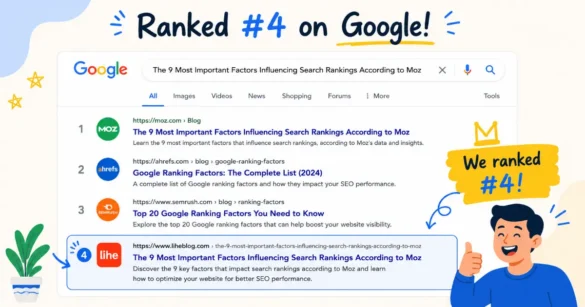
Looking at the essence of SEO from the phenomenon of “Zero keywords but ranking on the first SERP”: “Intent understanding” surpasses “Literal matching”
According to traditional SEO thinking, why can an article with zero keyword density be ranked 4th on the first SERP? The answer increasingly clearly points to factors other than keywords on the page, mainly including: semantic relevance, and the strong co-occurrence of brand words + core words.

The 9 Most Important Factors Influencing Search Rankings According to Moz
Moz regularly surveys leading SEO professionals to identify the ranking factors they consider most important. The top-ranked factor is "domain-level link authority features," followed by "page-level link metrics."

Don’t rush into WordPress SEO and SEM just yet—first, give careful consideration to these three things.
Effective WordPress SEO and SEM hinge upon three fundamental questions: First, clarify why users search—analyzing the true intent behind their search terms. Second, identify what users search for. Finally, understand how users search—paying close attention to evolving search scenarios and habits.

49 Strategies to Comprehensively Enhance Website SEO Performance
Through these 49 actionable strategies, website operators and SEO professionals can construct a robust and sustainable optimization framework—effectively boosting website visibility in search results, attracting more targeted traffic, and ultimately achieving a dual increase in conversion rates and brand influence. It is hoped that this serves as a practically valuable roadmap within the realm of digital marketing.

The search volume for short phrases and sentences consisting of 7 to 8 words has increased
The deep penetration of AI has brought both new opportunities and challenges to the field of SEO. One of the most significant trends in the SEO landscape is the ever-increasing length and complexity of search queries. The era in which simple two- or three-word searches reigned supreme is a thing of the past. Instead, people now pose detailed, conversational questions—a shift that signals an expectation for search engines to provide more precise answers.